

In an era where the world deals with the shadows of extremism and division, it is time for a reckoning within the Arab world. For too long, Arab – Islamic supremacy (Outdated ideologies of Arab dominance and caliphal glory) have fueled cycles of violence, oppression, and self-inflicted defeat. There is no greater terrorism than the brand of Arab-linked militancy that has scarred decades; no greater perpetrators of genocide than the supremacist forces that have erased cultures under the guise of conquest; and no more repugnant form of supremacy and racism than the one that dehumanizes others while claiming divine mandate. The evidence is irrefutable, drawn from history’s grim ledger. Yet, amid this darkness, there is a path forward: reform, modernization, and peace. The United Arab Emirates stands as a beacon of what is possible. It is time for the Arab world to follow suit, to teach its children love over hate, and to learn the lessons of coexistence with neighbors like Israel. Failure to do so risks not just regional stability, but the very soul of a people.
The Horror of Decades Long Arab Terrorism: Endless Plots
Arab terrorism, often cloaked in the rhetoric of resistance, has inflicted unparalleled suffering over the past century, turning legitimate grievances into global nightmares. Consider the Munich Massacre of 1972, where eight members of the Palestinian Black September group infiltrated the Olympic Village in West Germany, killing Israeli athletes and taking nine hostage
The botched rescue left all hostages dead, a tragedy that shocked the world and symbolized the hijacking of Palestinian cause by violence. This was no isolated act; Black September, born from the PLO’s expulsion from Jordan, orchestrated international strikes, including the assassination of Jordan’s Prime Minister Wasfi al-Tal in 1971.
The pattern persisted. In Jordan’s Black September conflict of 1970, PLO militants hijacked planes and clashed with King Hussein’s forces, sparking a civil war that killed thousands and expelled the PLO, paving the way for more radical offshoots.
Lebanon’s 1975-1990 Civil War, exacerbated by PLO militancy and Syrian intervention, devolved into sectarian carnage, with Arab-backed factions like the Lebanese National Movement fueling massacres and displacement.
These are not anomalies but a continuum: from the 1980s intifadas with suicide bombings to the 2000’s al-Qaeda plots, Rise of ISIS, and the 2023-2025 escalations in Gaza and Lebanon, where Hamas and Hezbollah—Arab – Iran backed proxies have perpetuated terror. The toll? Millions displaced, economies shattered, and a generation radicalized. Supremacist ideologies, not strategy, drive this, demanding an end to the delusion that violence begets victory.
Arabization: The Erasure of Diversity in Lebanon and Beyond
Compounding this terrorism is the insidious process of Arabization, which has systematically overwritten indigenous cultures. In Lebanon, once a mosaic of Phoenician, Maronite, Druze, and Aramaic heritage, Arabization accelerated post-7th century conquests, with Arabic supplanting local tongues by the 13th century. The 1975 Civil War amplified this, as PLO influxes and Syrian proxies imposed Arab nationalist agendas, eroding Lebanon’s confessional balance and fueling demographic shifts that marginalized Christians and Druze. Today, Lebanon’s identity crisis—exacerbated by Hezbollah’s Iran-Arab hybrid—reflects a lost pluralism.
This is no Lebanese anomaly. In North Africa, Berber (Amazigh) languages and cultures were suppressed under Umayyad and Abbasid caliphates, with Arabic enforced as the lingua franca from the 7th century onward. The Levant area saw Aramaic and Syriac communities Arabized through taxation (jizya) and intermarriage, reducing indigenous Christians to minorities by the Crusades. Even in Iraq and Yemen, Kurdish and Akhdam voices were silenced under pan-Arab regimes. Arabization was not mere assimilation; it was cultural genocide, prioritizing one identity over the rich tapestry of the region.
Caliphal Atrocities: The Bloody Legacy of Supremacist Genocide
There’s no greater genociders than Arab supremacists and caliphate rulers. The Umayyad and Abbasid eras (661-1258) were marked by mass slaughters: the 680 Battle of Karbala, where Umayyad forces beheaded Shia Imam Husayn and massacred his family, sowed eternal sectarian rifts. The Mongol sack of Baghdad in 1258 ended the Abbasids, but not before their rule had seen the forced conversions and enslavements of Zoroastrians in Persia and Hindus in Sindh, with millions killed or displaced.
Decades of caliphal expansion brought horrors. The Ridda Wars (632-633), where Caliph Abu Bakr crushed apostate tribes, killing tens of thousands to enforce unity. In India, Mahmud of Ghazni’s raids (1001-1027) under caliphal sanction destroyed temples and massacred Hindus, a “bloodiest story in history” per Will Durant.
The destruction extended to centers of learning, such as the 1193 Nalanda University massacre by Muhammad Bakhtiyar Khilji, a Turko-Afghan general acting under the broader caliphal mandate of expansion. Khilji’s forces massacred thousands of Buddhist monks, beheaded scholars, and torched the vast library—housing nine million manuscripts—that burned for three months, extinguishing a millennium of knowledge in philosophy, astronomy, and medicine. This act of cultural genocide, rooted in supremacist zeal to uproot non-Islamic traditions, was devastating. While there were more than 3,000 monks inside Nalanda during the attack, 200–300 Islamic invaders were able to kill them all. Buddhists never thought that there would be such an attack since they were unarmed and tolerant. They used to spread kindness to their own killers. The result was total eradication. The Nalanda incident symbolized the caliphates’ intolerance for diverse ideas.
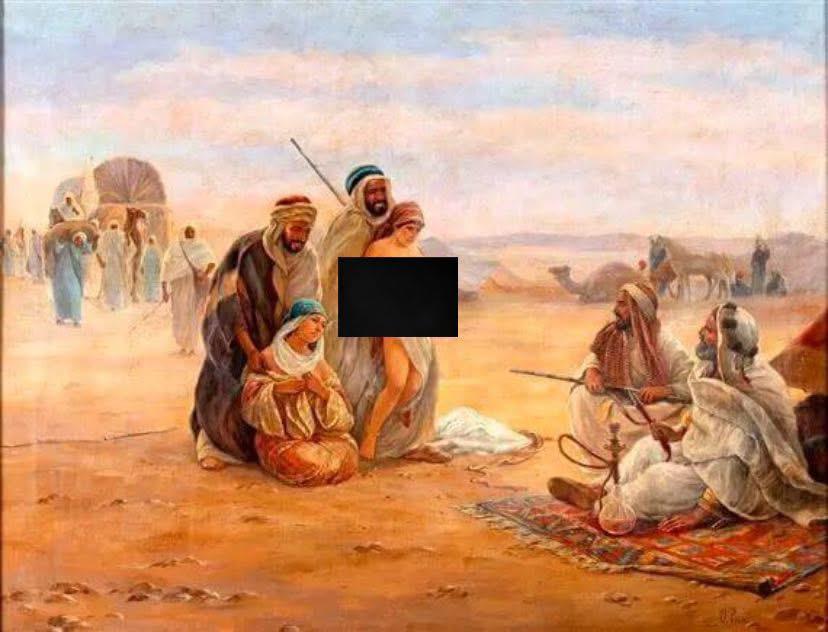
The Arab slave trade, spanning 1,300 years, trafficked 6-10 million Africans, with castration of males and concubinage of females as norms. These were not wars of defense but supremacist expansions, echoing in ISIS’s 2014-2019 Yazidi genocide, where caliphal fantasies justified rape and slaughter.
Modern Shadows: Racism, Slavery, and Exploitation in Arab Lands
This legacy festers today in racism and modern slavery. Gulf states, under kafala systems, trap migrants in debt bondage. In Qatar, South Asians and Africans face “structural racism,” with Arabs enjoying privileges denied to others—racial profiling in malls, wage theft, and heatstroke deaths during World Cup builds. It safe to say last FIFA world cup bulid on bloods and tears of poor south Asian families. FIFA tragedy is just a small fraction of this modern day slavery.
Sri Lankan women fleeing poverty face sexual violence and passport confiscation. Even Bangladeshi and Pakistani Muslims were treated harshly, despite their religious similarities. Most of these South Asian immigrants come from the poorest families in the region. Middle-class South Asian immigrants and even lower-middle-class usually focus on Western and East Asian countries for job opportunities. Poorest families usually fall into traps set by agencies. Most of them take risks to work in the Middle East so they can build a home and get basic needs for their children. But a significant number of them ended up with terrible, harsh treatments. Some get raped, beaten, and even killed. I personally encountered some Sri Lankan women who went through such a terrible fate. Once, coming from Israel to Sri Lanka on FlyDubai, I met a group of women who worked in Kuwait. We had a chat while we traveled to Colombo from Dubai. One woman worked with a British family in Kuwait. She, however, never faced abuse. The family treated her with respect. Others worked in Arab families, and those three women got beaten often by their owners. One of them even complained to the Sri Lankan embassy about sexual assault. It was that terrible. When we reached Colombo, those three cried so hard and repeatedly chanted some Buddhist verses. That emotion shocked me. One woman said, “I’ll clean toilets, will sweep the road, or maybe me and my family can live on the road. That is more than enough for me. I survived Kuwait. There’s no terrible fate than that.” I believe her story more than a load of bs in Al Jazeera and AJ Plus any day. What I know is the story of these South Asians is not going to be viral, or celebrities are not going to talk about them at the Academy Awards. Because Qatar will not fund them for that anyway. AJ Plus presenters will never create those emotional contents about them because subhumans like us (according to many Arab supremacists) do not deserve to be treated as human beings anyway. ( I went too far with this emotional incident, but it’s part of our major story.)
Hidden sex slavery thrives in the region. Trafficked Filipinas and Ethiopians serve as sex slaves in Saudi harems, reminding caliphal eras. Racist policies abound—Sudan’s Arab militias’ Darfur genocide, Libya’s anti-African pogroms, Egypt’s Nubian marginalization. Remarks like “slave” hurled at Black migrants reveal attitudes unchanged since the trade’s end. These are not relics; they are policy, with Qatar’s World Cup exposing 6,500 migrant deaths.
A Call to Reformation: UAE’s Model and the Imperative of Peace
Arabs must change these attitudes now, preparing for a modern world that rewards skills over hate. The UAE exemplifies this: from desert outpost to global hub, it has modernized through Vision 2031, investing in AI, smart cities, and education—its GDP soaring 3.8% annually via infrastructure like Burj Khalifa and Palm Jumeirah.
Reforms abolished kafala elements, boosted women’s rights, and fostered tolerance, attracting 88% migrant talent while preserving heritage. Dubai’s innovation funds and inclusive curricula show progress without erasure.
Palestinians, in particular, must love their children more than hate Jews, reforming education to prioritize futures over martyrdom. Massive overhauls are needed: curriculum de-radicalization, women’s empowerment, and economic diversification. Arab nations should open pathways to other faiths, ending apostasy laws and blasphemy edicts that stifle reform.
Crucially, learn to live peacefully with Israel. Attempts to erase the Jewish nation in 1948, 1967, 1973, the 1980s intifadas, 1990s bombings, 2000s rockets, and 2023-2025 wars have failed miserably, costing Arab lives and treasuries. Arabs must understand that other people are no longer subjects to their caliphate dreams. Arab supremacy, built on hate and delusion, breeds only isolation. The pathway to a safe, stable future lies in respecting fellow nations—trade with Israel, normalize borders, invest in shared prosperity.
The Arab world stands at a crossroads. Clinging to stupidity and hate invites ruin; embracing reform invites renaissance. The delusional idea of killing all others and make some kind of caliphate not going to happen. Change now, or history will judge harshly. Peace is not weakness; it is victory.