
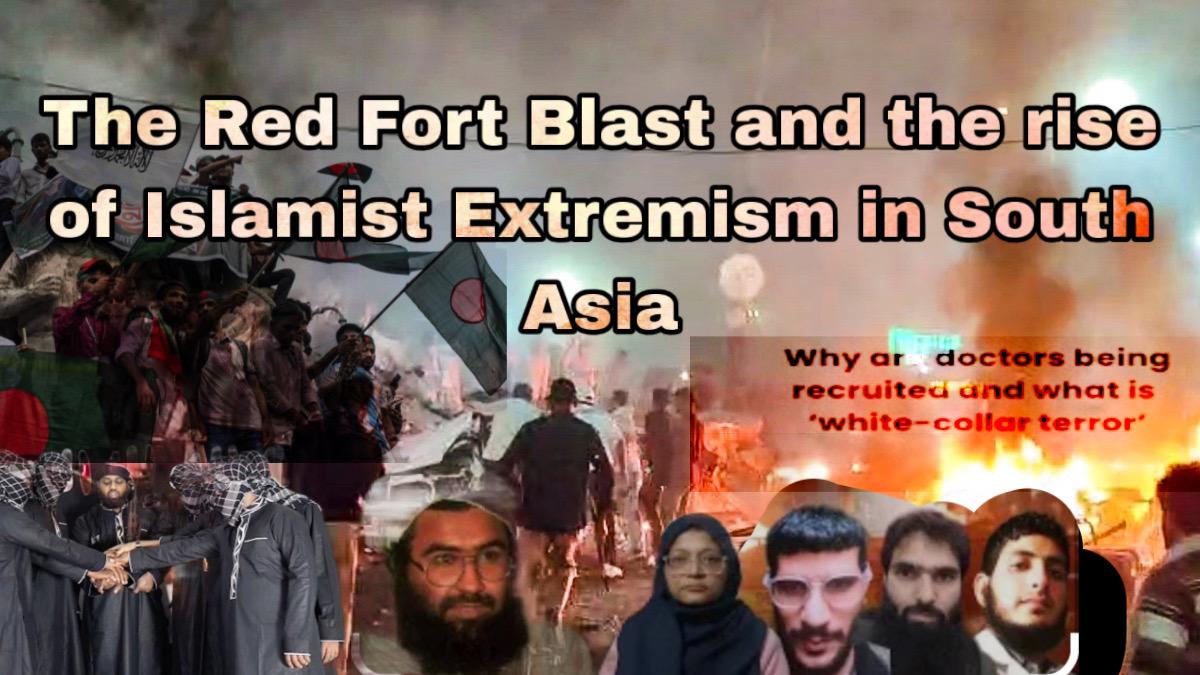
So far the Red Fort Blast has claimed at least 13 lives. All these recent terror attacks show us the grim reality. South Asia is on the brink of becoming the world’s next red spot of Islamist terrorism, due to weak borders, political instability, power vacuums, and unchecked radical networks. Most pundits say it’s going to be Africa. But the point is all those Islamist atrocities in Africa and large-scale wars were a thing in that part of the world for decades. South Asia was on its track to achieve some remarkable economic goals. A few years ago I was so optimistic about the future of Asia. We saw Abraham accords between Israel and Middle East nations. We had a hope for having new trade routes that can connect Europe, the Middle East, and South Asia. However, even if many of us were happy, some nations like Iran were furious about the developments in the Middle East. On the other hand, Pakistan had its rivalry against India. While India achieved significant economic goals, Pakistan suffered from China’s debt trap. They perfectly knew they were not going to be a strong part of these future developments. Plus, lunatics who are obsessed with expansionism and jihad are the ones who run these countries. Khomeini would rather see all of his people suffer from a water crisis than a stable Middle East without proxies. Pakistan would rather be an agent of chaos and extremism than become a trade partner and secular nation with tolerance.
Let’s go back to the Red Fort incident. According to investigators, this was not a random act of violence, but rather a calculated strike carried out by the Pakistan-based Jaish-e-Mohammed. Dr. Mohammad Umar Nabi, a Kashmiri doctor from Pulwama, panicked after a JeM terror module was busted in Faridabad, Haryana, just days before. Umar, a member of a radical doctor’s network that communicates via Telegram, allegedly detonated the device while en route to a larger target. What we can clearly see here is that the explosion was planned precisely with a symbolic attack on the nearby Gauri Shankar Temple, an 800-year-old Shiva shrine opposite the Red Fort. It seems that this radical Islamist group wanted to send a clear message to both the BJP government and the Hindu community. If things had gone their way, there might have been a significant escalation between the two communities, which would have created an ideal ground for a massive rise of Islamist extremism filled with pride and revenge.
Amid the grief, India’s intelligence deserves credit for averting greater catastrophe. Just weeks before the blast, Gujarat’s Anti-Terrorism Squad (ATS) dismantled an ISIS-linked module in Ahmedabad, arresting three operatives mid-weapons exchange and foiling plots across multiple cities. In September, Delhi Police raided a terror cell, nabbing suspects Aftab, Sufiyan, and Ashar Danish, who were plotting large-scale strikes with foreign handlers.
These successes stem from upgraded surveillance, inter-agency coordination, and lessons from past Congress administration failures like the 2008 Mumbai attacks. The Faridabad bust itself was a masterstroke: 2,900 kg of explosives, timers, and arms were recovered from rented rooms linked to Dr. Muzammil Shakeel, another Pulwama native. Among the arrests was Dr. Shaheen Shahid, a Lucknow-based doctor from Lal Bagh, tasked with building JeM’s women’s wing, Jamaat-ul-Mominat, in India. Her brother, Dr. Parvez Ansari, was also detained, with an AK rifle and pistols found in her vehicle.
However, Intel can stop 1000 attacks, but all terrorists have to do is pull off just one terror attack. That makes things harder for intel officers. They can have a 99% success rate and yet get blamed. Meanwhile, terror groups just get what they want with less than a 1% success rate. Just one. It would create massive panic among the people. It will show them as an impactful group; they can set examples and become heroes among radicalized communities.
Nepal, the transit
The blast’s ripples extend far beyond India. JeM and LeT are widening their footprint in Nepal, exploiting the open Indo-Nepal border as a transit for arms and operatives. Nepalese officials, including Presidential Advisor Sunil Bahadur Thapa, have warned that these groups view Kathmandu as a launchpad for strikes into India. Hawala networks tied to Jamaat-e-Islami funnel funds across the subcontinent, sustaining ops in India, Bangladesh, Nepal, and even Sri Lanka.
Bangladesh, the New Harvard for terrorism
Bangladesh has had the problem of Islamist extremism since its existence. Some might disagree, but the ill treatment toward Bangladesh Buddhists and Hindus was always (and still is) kind of its national sport. (Cricket is a popular sport in the country, but they are not really good at it.) But Bangladesh’s political leadership had good ties with India. The Hasina administration was sensible when it comes to the economy and way more tolerant towards minority non-Muslims compared to Yunus’s administration. A wave of instability made things worse by removing Hasina from power. What we have now in Bangladesh is basically Harvard for terrorism.Al-Qaeda in the Indian Subcontinent (AQIS) and ISIS-linked modules are systematically recruiting via online propaganda, targeting urban youth with lone-wolf attack guides against Indian targets. Bangladesh’s Directorate General of Forces Intelligence (DGFI) has initiated guerrilla warfare training for select members of the Rohingya community.
Is Bangladesh the next “Harvard for terrorism? All the evidence points to yes.
Sri LANKA, The Ignorant lefty
Sri Lanka has its own demons. The 2019 Easter Sunday bombings—coordinated by National Thowheed Jamaath (NTJ) under Zahran Hashim, with ISIS approval—killed 269, targeting churches and hotels in a bid to spark global jihad. The FBI’s affidavit confirms Hashim’s role as ISIS’s self-proclaimed Sri Lankan emir, with video pledges and Syrian training. On May 20, 2024, the Gujarat Anti-Terrorist Squad (ATS) arrested four Sri Lankans suspected to be Islamic State of Iraq and Syria (ISIS) terrorists at the Sardar Vallabhbhai Patel International Airport in Ahmedabad, India. Three Indian Premier League cricket teams were scheduled to arrive ahead of the 2024 playoffs. The government at that period didn’t take it seriously. The same happened in 2016. In 2016 the Sri Lankan Minister of Justice revealed yesterday that information has been received regarding 32 Sri Lankans, belonging to four rich elite Muslim families, who joined the Islamic State (IS) movement in Syria. At that time many so-called moderate Muslim parliamentarians accused the minister of spreading racism, and those kids were from good families; they went for education. However, within months it turns out that minister was right after all.Is Sri Lanka ready for this grim reality? Hardly. Gaps in intelligence sharing persist, and DE radicalization efforts falter amid political paralysis. The newly elected government has no sense regarding national security, and they played the same minority block vote politics just like previous regimes. Also there’s a huge whitewash propaganda going on in Sri Lanka, which makes people less aware of Islamist extremism. Those who try to speak up eventually get branded as Islamophobics and racists. A wave of political instability—from Bangladesh’s jihadist coup to Nepal’s proxy vulnerabilities and Sri Lanka’s ignorance and stupidity—is eroding the subcontinent’s foundations. Pakistan, on the other hand, is doing everything they can to make things much worse. India’s Afghanistan normalization is not going to do anything good, and if Congress comes to power, the situation will be even worse due to their vote base. Islamist extremism thrives in these cracks. South Asian Muslim youth are slowly becoming cannon fodder for caliphate dreams. This is not going to end well for anyone. South Asia is more complex than many parts of the world, and its youth has more access to the world. Unlike Africa’s rise of Islamist terror, this is going to be a global issue. We have to act now or never. South Asia must confront a hard truth. Slowly but steadily, the subcontinent is becoming the next red spot on the global terrorism map.