

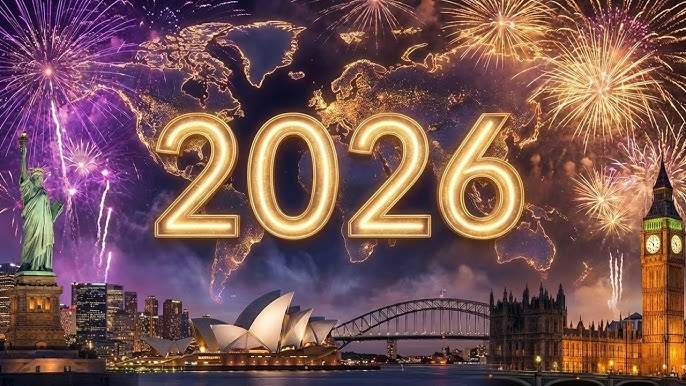
While you are just firing up the BBQ on New Year’s Eve, some islanders in the Pacific are already asleep after their fireworks faded hours ago. That’s the strange magic of time zones. The New Year does not arrive everywhere at once but sweeps across the planet like a slow, glittering wave. The Pacific Islands of Kiribati are the first nation to welcome 2026, as they are just next to the international date line.
Japan, New Zealand and Australia are the first batch of widely known nations to welcome the New Year.
New Year, or Shogatsu, is viewed as the most important holiday in Japan, with festivities that are deeply rooted in culture lasting from 31 December to 3 January.
In this period families gather together, businesses cease trading and homes are decorated with bamboo and pine ornaments.
Among the traditional activities. Food plays an important part of celebrations, with buckwheat noodles symbolising longevity served on New Year’s Eve, and a special family meal called Osechi Ryori, which often consists of colourful dishes, eaten on 1 January.
Shrines and temples are traditionally visited during the New Year period, when bells are rung at midnight on New Year’s Eve – see our previous post for this year’s bell-ringing.
Another custom is the gifting of money to children by adults as a way of showing appreciation and giving them hope for the coming year. New Year’s Day postcards are also sent between friends and relatives to offer greetings to distant loved ones.
The most significant time zone would be ground zero, which is London and, more accurately, the Greenwich meridian. It is the prime meridian of the Earth. Like all other commercial capitals, like New York, Rome or Paris, London would be ready for 2026 with its best preparations as always.
The Continental United States would be another story. Cities like New York, Washington, and Boston on the East Coast will be celebrating before the middle and western parts. Los Angeles, San Francisco and Seattle will be in a separate league.
The last inhabited place to welcome the New Year is American Samoa, a US island territory in the Pacific. By the time midnight strikes here, nearly the entire planet is already living in the new year. Just 70 kilometres away, Samoa sits on the opposite side of the International Date Line, creating a 24-hour gap between them.
This peculiar time gap allows adventurous travellers to pull off the ultimate party trick. They ring in the new year in Samoa first, then hop over to American Samoa to do it all over again. Uninhabited US territories like Baker Island and Howland Island technically see the New Year even later, though the only witnesses there are seabirds and the stars.