
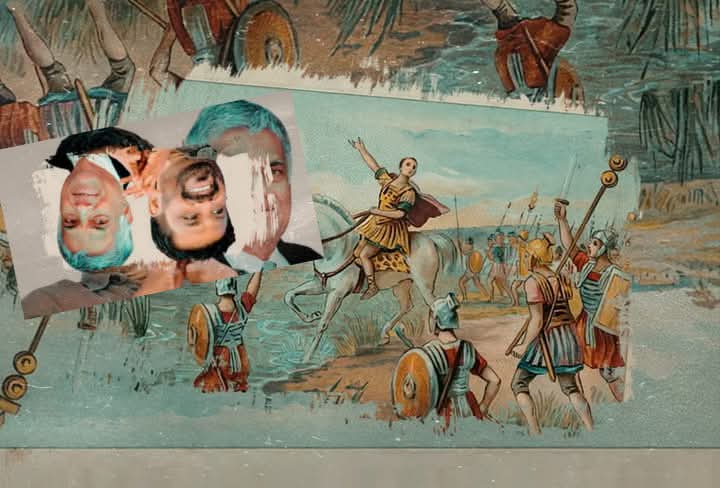
In 49 BC, Julius Caesar stood at the banks of the Rubicon River, a boundary marking the edge of his province. Crossing it with his army was an act of defiance against Rome’s Senate, a declaration of war that would reshape the Roman Republic. The phrase “crossing the Rubicon” has since come to symbolize a decisive, irreversible step. Now, Sri Lanka appears to have crossed its own Rubicon with the unprecedented arrest of former President Ranil Wickremesinghe on August 22, 2025, a move that has sent shockwaves through the nation’s political landscape.
For the first time in Sri Lanka’s history, an executive president has been detained, marking a dramatic escalation in the country’s battle against corruption. Wickremesinghe, a political titan who served as president from 2022 to 2024 and as prime minister six times, was arrested by the Criminal Investigation Department (CID) for allegedly misusing state funds during a 2023 London trip to attend his wife’s university ceremony. The charges center on claims that public money funded what was essentially a private visit, costing approximately 17 million Sri Lankan rupees ($56,000), including expenses for his security detail.
New era of accountability—or, a dangerous politicization of justice ?
Wickremesinghe’s arrest raises questions about the motives behind it. If, as his critics have long claimed, he was complicit in serious scandals like the 2015 Central Bank bond scam or the alleged human rights abuses linked to the Batalanda detention center in the 1980s, why were these not the basis for his prosecution? The bond scam, which involved alleged insider trading that cost Sri Lanka billions, and Batalanda, where Wickremesinghe was accused of overseeing extrajudicial detentions during the JVP insurrection, have been rallying cries for his opponents for decades. Yet, the current charges focus on a relatively minor issue—a London stopover. This selective focus fuels speculation that the arrest may be less about justice and more about political theater, possibly a move to weaken the old guard.
Is this a Marxist takeover
The National People’s Power (NPP), led by Dissanayake, has roots in the Janatha Vimukthi Peramuna (JVP), a Marxist-Leninist party with a history of revolutionary zeal. The JVP’s past, marked by violent uprisings in the 1970s and 1980s, lends credence to fears that the NPP’s rise could signal a return to radical ideological roots. However, the NPP has worked to project a broader, more inclusive image, distancing itself from the JVP’s militant history. The arrest could be a calculated move to cement the NPP’s anti-corruption credentials, but it risks being interpreted as a slide toward authoritarianism. especially if due process appears compromised.
Wickremesinghe’s tenure as president was defined by his navigation of Sri Lanka’s catastrophic 2022 economic crisis. Taking office after Gotabaya Rajapaksa’s resignation amid mass protests, he secured a $2.9 billion IMF bailout, stabilized the rupee, reduced inflation, and rebuilt foreign reserves. Yet, his austerity measures—doubling taxes and slashing subsidies—drew public ire, making him a polarizing figure. Despite losing the 2024 election to Dissanayake, finishing third with 17 % of the vote, Wickremesinghe was not a direct political rival in the traditional sense. There was an strong understanding between the two, with Wickremesinghe’s UNP offering tacit support to the NPP’s early governance efforts. This makes the arrest all the more jarring, raising the question: why now, and why this charge?
The possibility of internal divisions within the NPP cannot be dismissed. The coalition, while unified under Dissanayake’s leadership, comprises factions with differing priorities. Hardline JVP elements may be pushing for a more aggressive purge of the old guard, seeing Wickremesinghe’s arrest as a symbolic victory over the political elite. Moderates, however, may view this as a risky overreach, especially if it galvanizes opposition from the UNP and other traditional power bases.
Caesar and Rubicon
Sri Lanka stands at a crossroads. Wickremesinghe’s arrest could mark the beginning of a vendetta-driven governance style that risks alienating key stakeholders. The international community, including the IMF, which tied its bailout to governance reforms, will be watching closely. Any hint of political revenge could erode trust and jeopardize recovery efforts.
Like Caesar, who crossed the Rubicon and emerged as Rome’s ultimate ruler, Sri Lanka’s political saga is far from over. Will Anura Kumara Dissanayake seal the deal Or will Ranil Wickremesinghe, the master of South Asia’s greatest political comeback in 2022, defy the odds once more?